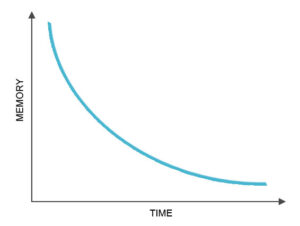
 Let’s say you know nothing about a topic before a lesson starts. In which case you know 100% when it is over.
The next day, if you do nothing with the information from the lesson (meaning: you do not read it again, do not think about it again) you will lose 50–80% of what you learned.
Your brain continuously registers information and has to decide what is necessary and what is not. What is not necessary, your brain forgets.
After a week you remember even less, and after a month only 2–3% is left of what you had after the original lesson.
That is… if you do nothing with it.
You can influence the curve by going through the information again.
Every time you repeat this, it becomes easier to activate the information again, and your memory improves.
The most effective way to use your time:
- within 24 hours: spend about 10 minutes going through the information.
- after a week, spend about 5 minutes reactivating the material.
- after a month you then only need 2–4 minutes.
If you use about half an hour a day, that is about 2 hours a week, you move the information from short-term to long-term memory.
This will save you an enormous amount of time preparing for tests and exams.