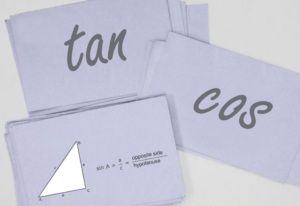
 Flashcards have been around for a long time. The book *Reading disentangled*, written by Favell Lee Mortimer in 1834, is considered the first book based on the principle: chapter 1 shows pictures with letters, and chapter 2 only the letters, with an instruction to the teacher “that the child should continue to name the pictures from the first chapter”.
In the 1970s Sebastian Leitner presented a simple, effective way to drill facts. It is easy to see how useful this is for cramming words in a foreign language, but flashcards work just as well for mathematical formulas, for example.
By going through the cards periodically you refresh your memory and partly undo the forgetting curve.
Making the cards themselves is simple. Use a size you can easily stack and go through, for example business-card or credit-card size.
On the front you write one or a few keywords; on the back you write what you have to know by heart — formulas, diagrams or figures, foreign-language words, whatever it may be. Keep it short and you save a lot of time. You can also flip the cards: start with the answer and find the key.
There are many websites and apps with electronic versions; Wikipedia has a full list.
If you want to steer the learning yourself, use Leitner’s model:
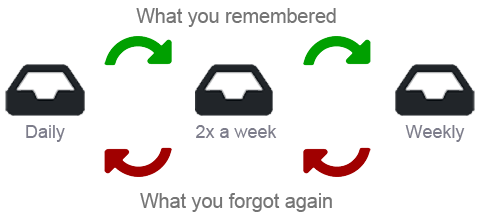
- When you start, the cards are in one pile that you go through often. Every card where you remembered the answer, you move to pile 2, which you go through less often. Go through pile 2 every day.
- After two days, go through pile 2. Every card where you remembered the answer, you move to pile 3. Every card where you had forgotten the answer, you move back to pile 1.
- Weekly you go through pile 3, and every card where you do not remember the answer, you move back to pile 2.
You can of course adjust the frequency to what you need. Remember also that writing the answers, or saying them out loud, helps you move the information into long-term memory.